Col de Tende or Colle di Tenda
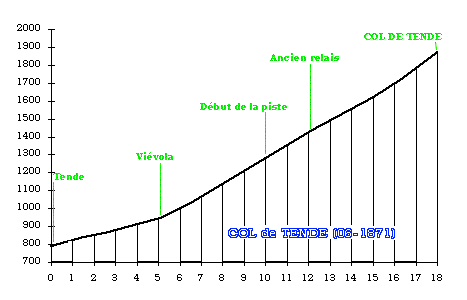
Col de Tende (FR-06-1871 or IT-CN-1871), located on the Franco-Italian ridge, provides a link between the Roya valley in the south and the Piedmontese Vermenagna valley in the north. It is the lowest pass between France and Italy. The French side is mule tracked, unlike the Italian side, where only the last 600 metres are unpaved.
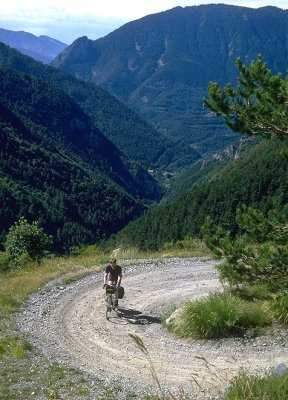
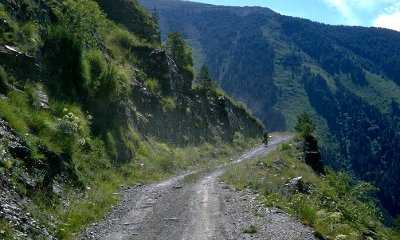
The trail starts just outside the road tunnel and winds its 46 twists and turns spectacularly over the upper Roya valley for around 7.5km. The view from the top is superb, but beware of the frequent thunderstorms in summer.
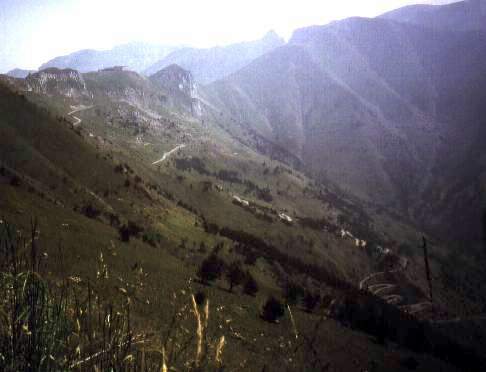
Near the summit, on the ridge, you can see the imposing mass of the fort.
central. Beyond this begins the long, strategic track of the Tende-Est ridges.
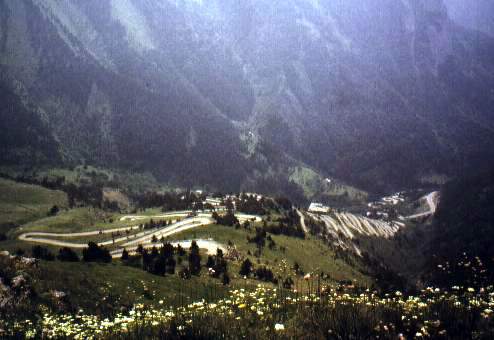
At the bottom of the Roya valley: the modern road through the Tende tunnel.
Halfway up the slope: the large building of the former guardhouse.
From either side of the summit, strategic trails lead to a large number of passes on the «West and East of Tende» loops (see TOPO 3).
But climbing passes doesn't mean you can't take an interest in their history, and the history of the Col de Tende is particularly rich. The first mention of a maintained road between Ventimiglia and Borgo San Dalmazzo dates back to 1178! Throughout the Middle Ages, the pass was used by caravanners delivering salt to the Po plain. The Roya valley was enriched by this lucrative trade, which was copiously ransomed by the lords of Tende... 16,000 mules crossed the obstacle every year!
The pass has seen many invaders pass through, the most famous of whom was Charles V in 1536, but it has also seen travellers take an awkward route, helped by a whole guild of «passers», known here as «collants» or «coulants» (of the pass...). Carriers could be hired to take turns crossing the pass in five hours for a small fortune. As early as the 16th century, a tunnel project was launched, and work even began (the entrance to this old tunnel can be seen on the Italian side at around 1750m altitude). But nothing came to fruition due to a lack of funds. It wasn't until 1780 that King Victor Emmanuel III (Piedmont-Sardinia) financed work on the current track, which was built after four years of effort. Just before the halfway point of the climb, a guardhouse was set up, housing 30 men. Their job was to ensure the safety of the route and provide assistance to travellers, especially in winter. This guardhouse still exists today.
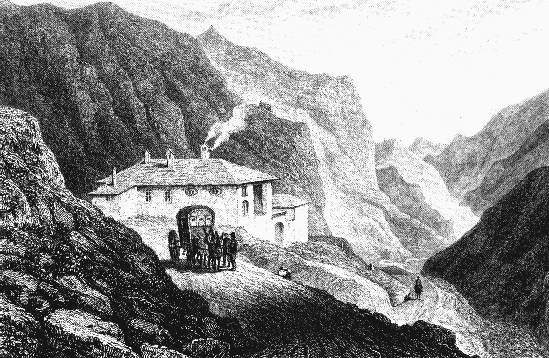
The route was not only used for trade: in 1794, revolutionary troops crossed the pass and invaded the kingdom of Piedmont-Sardinia, while on 25 April 1945, the first FFL division crossed the pass after liberating the Roya from its last German occupiers. This strategic importance is demonstrated by the presence of imposing military forts at the summit and on either side of the pass.
Enjoy the climb!
René POTY
 Français
 English (UK)
 Italiano
 Deutsch
 Español
 Nederlands (België)